

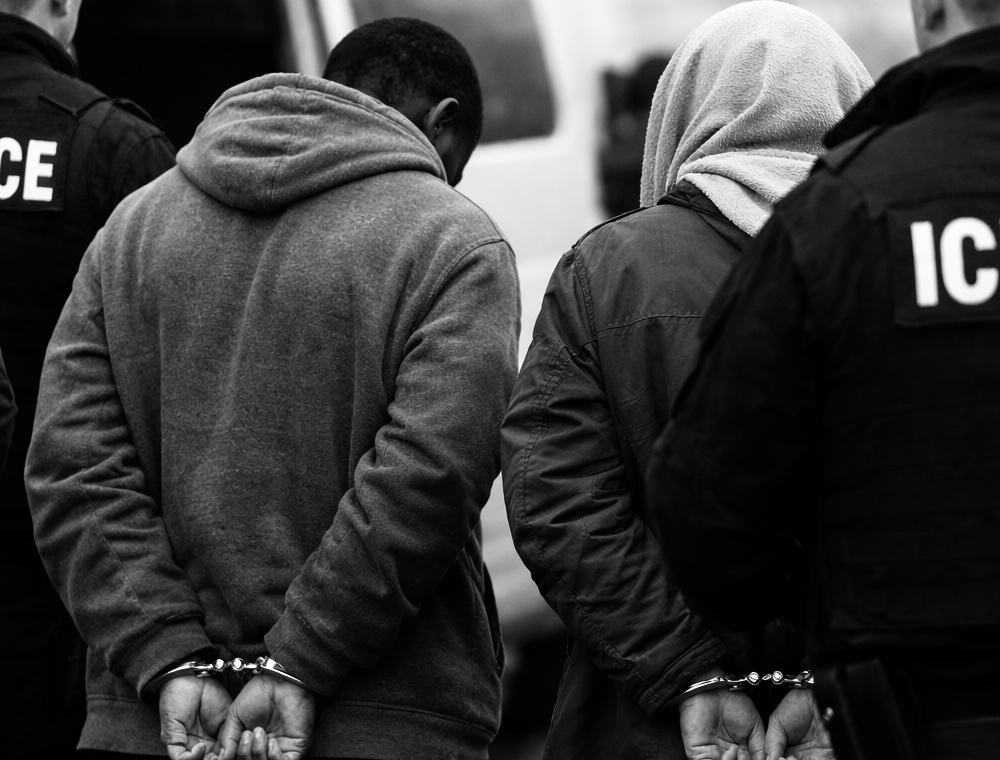
Recent reporting from Christianity Today and federal court filings in Minnesota have brought renewed attention to a policy shift affecting legally admitted refugees in the United States. According to disclosed documents, some refugees — already vetted, approved, and resettled — were detained by U.S. Immigration and Customs Enforcement under a new directive issued by the Department of Homeland Security.
These are not individuals who crossed the border unlawfully last week. These are people who underwent years of overseas screening, biometric checks, interviews, and federal approval before being admitted into the U.S. refugee program. They arrived legally. They complied with the process. They began rebuilding their lives.
And then some were detained.
This development deserves careful attention — not panic, not outrage — but serious consideration.
What Changed?
Under prior policy, failure to obtain a green card within one year was not itself grounds for detention or removal. If a refugee was arrested, the government was required either to release the individual within 48 hours or initiate formal removal proceedings.
A newly surfaced DHS memo alters that posture. The memo states that previous department policy “created a population of conditional refugees who had not been fully re-screened, with associated public safety and national security risks.” It introduces a “detain-and-inspect requirement” intended to ensure refugees are re-vetted after one year.
It also indicates that refugees who submit application paperwork or appear for scheduled immigration appointments may be considered to have “voluntarily returned to custody” during this re-inspection process.
Supporters of the policy argue it strengthens national security and corrects procedural gaps. Critics argue it destabilizes individuals who were already lawfully admitted and who relied on the consistency of the legal system.
A federal judge in Minnesota has temporarily blocked the administration from targeting an estimated 5,600 lawful refugees in the state who are awaiting green cards, and litigation is ongoing. Legal advocacy groups, including the International Refugee Assistance Project, are challenging the new approach.
At the same time, the current administration has significantly reduced refugee admissions nationwide. The annual ceiling has been lowered to 7,500 — a sharp decline from the more than 100,000 refugees admitted in 2024. Broader efforts to re-interview certain refugee populations and re-examine previously issued green cards have also been announced.
This context matters. Governments have a legitimate responsibility to address security concerns.
But stability matters too.
Why This Is Different
Refugees are the most heavily vetted category of immigrants in the United States. They do not simply arrive and request protection. They are screened overseas, often for years, before being admitted.
The modern refugee system was formalized under the Refugee Act of 1980, which established a structured and bipartisan process for offering protection to individuals fleeing persecution. That system communicated something simple but powerful: if you qualify, and you comply, you may begin again in safety.
When people who followed that process face detention under a newly interpreted procedural requirement — not because of a new crime, but because of a re-inspection policy shift — uncertainty enters what was previously understood as secure.
Uncertainty does not remain confined to one group.
It affects refugees waiting on green cards.
It affects asylees adjusting status.
It affects families navigating lengthy bureaucratic backlogs.
At its core, this issue is not about whether immigration laws should exist. It is about whether lawful processes remain predictable.
The Larger Civic Question
A functioning legal system depends not only on enforcement, but on reliability. Citizens and non-citizens alike must be able to trust that compliance with the law carries meaning.
Policy can change. Administrations can reinterpret statutes. Elections bring different priorities.
But when individuals who were vetted, approved, and welcomed under one framework face detention under a new procedural shift, it raises a broader civic concern: can people rely on the stability of lawful pathways?
National security is not a trivial matter. Governments must have the authority to address credible threats. But credibility also depends on transparency and consistency.
When rules appear to shift after compliance, trust erodes — and trust is foundational to institutional legitimacy.
A Measured Response
This moment calls for vigilance, not hysteria.
First, the public deserves clarity. What specific security gaps does the new policy address? How will re-vetting be conducted? What safeguards prevent arbitrary detention of individuals who pose no demonstrable threat?
Second, legal challenges should proceed in the open. The courts play an essential role in ensuring executive actions align with statutory and constitutional limits.
Third, communities should resist fear-driven narratives. Security and compassion are not mutually exclusive. A nation can uphold strong enforcement while also ensuring lawful refugees are treated with fairness and transparency.
Finally, it is reasonable — and responsible — for Americans to ask whether policy shifts preserve both national safety and institutional trust.
The Question Before Us
The refugee system has long signaled something hopeful about the United States: that those fleeing persecution can find protection under law.
If that protection begins to feel conditional after compliance, the implications extend beyond one memo, one lawsuit, or one administration.
This is not a call to panic.
It is a call to pay attention.
Because when lawful protection becomes uncertain, vulnerability expands quietly.
And when refugees who followed the rules begin to feel unsafe, the question naturally follows:
If refugees aren’t safe, who is?


